
Quarantine Day 2: Doorknobs and Scary Pictures

A few pictures from quarantine:
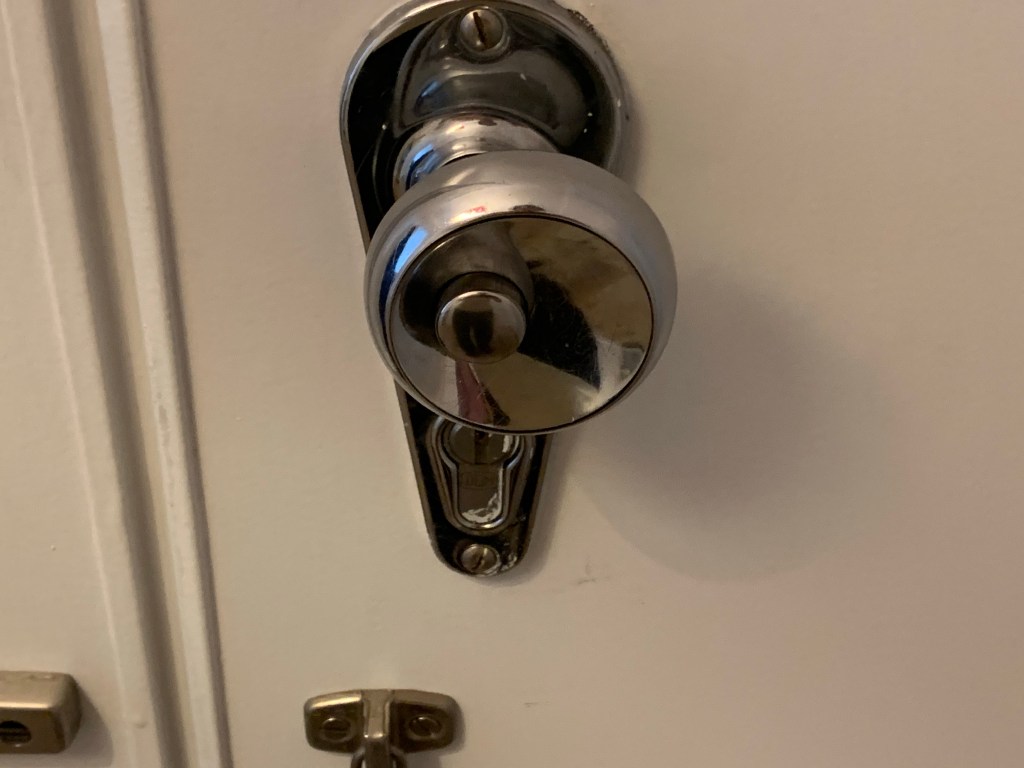
A concave silver doorknob with a button on it, slightly off-center to the left.
A doorknob!

The doors in this building were a surprise: first of all, see the button on the knob? The first time I saw it, I assumed you pressed it to lock the door. Sadly, like they say, that just made an ass of me and umed. Pressing these buttons is actually the only way to open the doors.

I also had a moment of worrying I couldn’t get into the apartment. Putting the key in the keyhole and turning it to the left unlocks the front door, but turning it to the right engages a second lock—when I tried turning it to the right, then to the left, at first it seemed like neither way worked.

A bag of oatmeal and a wooden paddle sitting on a stovetop.
Oatmeal and a stirring tool.

One thing I like from the kitchen here is this wooden paddle. The only things I’ve made so far are oatmeal and sandwiches, but the paddle works really well for stirring oatmeal in the pot.

I’ve been pretty obsessed with oatmeal lately (for the past couple weeks, I guess?). I found a nice recipe here.
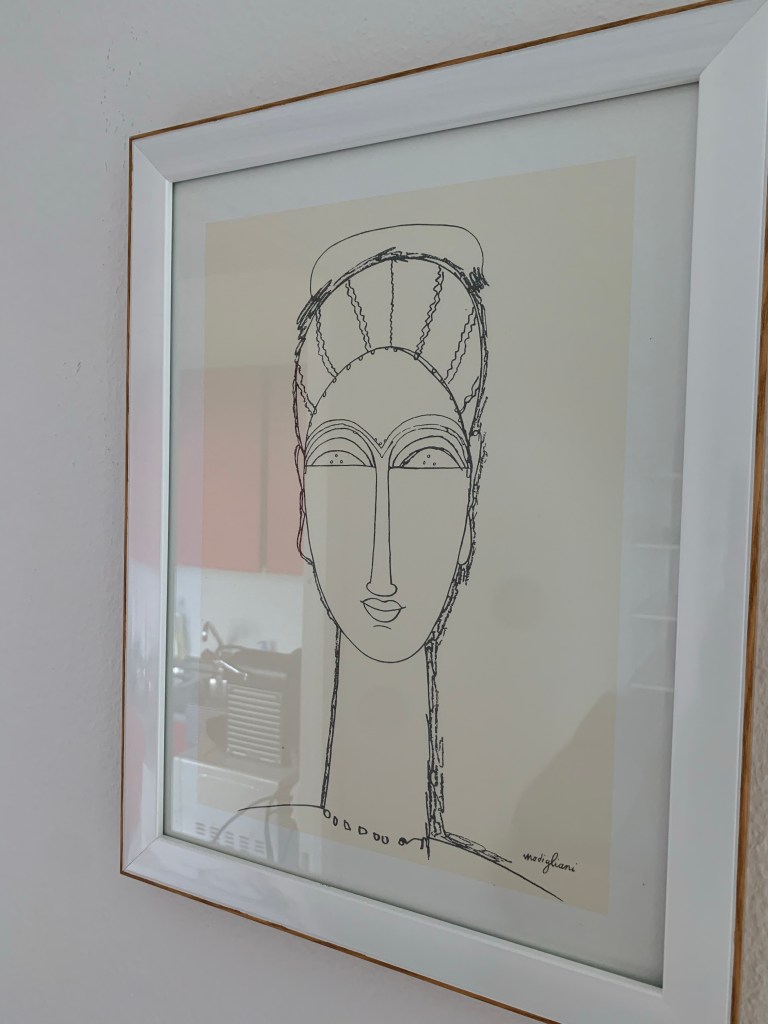
A scary-looking drawing of a person with a neck that is too long.
Scary picture.

The art in this apartment is eclectic, but most of it is fairly normal. This picture just scares me, though. (I guess it’s all a matter of taste!)

It reminds me of my first time in Japan: there was a scary statue that could sometimes be seen propping open a door on the street outside my dorm building. I couldn’t find a picture of that one, sadly.

A dial from a laundry machine with text around it in German.
German laundry machine dial.

I’ve been studying French (the main language spoken in Geneva) for about three weeks. It will take a while longer before I learn enough for it to really come in handy. However, there’s a lot of stuff here in German, too, which is the most common language in the rest of Switzerland. Even if I can get my French in shape, I’ll still have to use Google Translate for things like this washing machine.

Most Netflix shows I’ve checked come up in German, too, with no French available. Netflix might be missing out on Geneva-ite customers who only speak French.

Switzerland feels a lot more foreign to me than Japan did, so far—unless there is an English option, I still can’t understand much of anything.
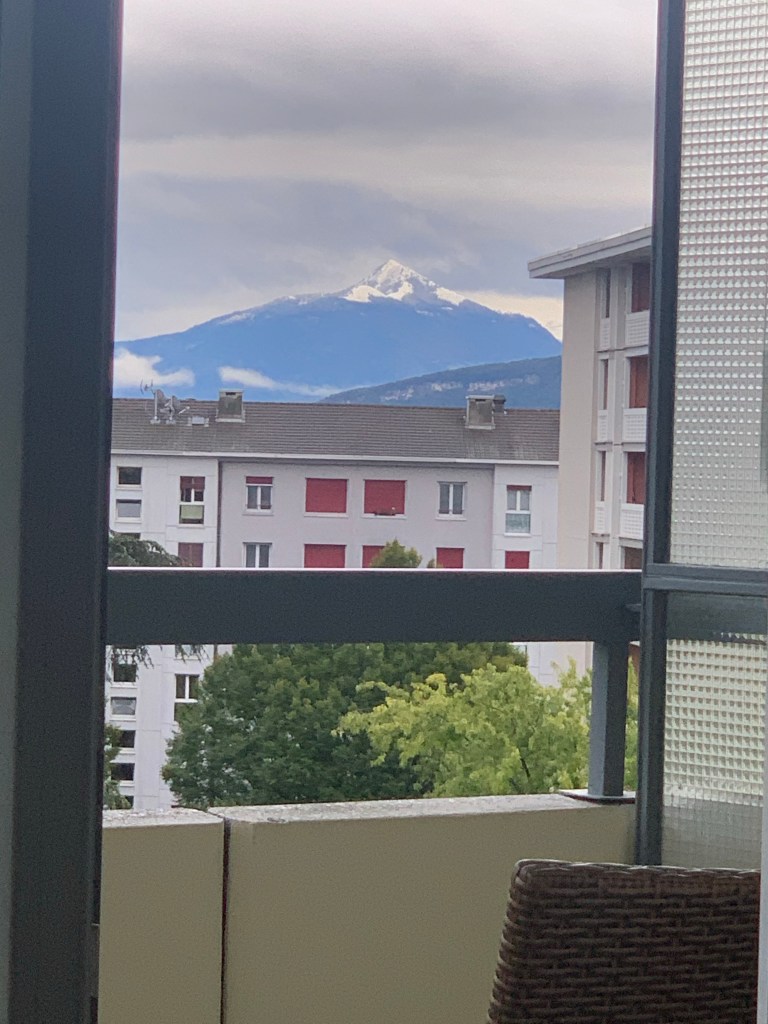
The view of a mountain from a balcony .
Mountain.

The balcony here offers a pretty view of some mountains. This one has snow on top in the mornings and seems to melt throughout the day.
Airports in the Age of Covid, or: What’s the Deal with Airline Food?

I recently had to travel to Switzerland on a work visa—I just arrived yesterday, and am now on the first day of a 10-day quarantine. This is mandatory for all travelers coming from places considered high-risk countries (including the U.S.), and I think it makes a lot of sense. My experience on the way here, though, makes me fear that airports and airplanes themselves might be the most “high-risk” zones of all.

Of course, this is not to disparage airline workers. They are doing their best to take the viral lemons life has dealt them and make them into safe-travel lemonade, and anecdotally, they did a very good job. The passengers who fail to follow mask and social-distancing guidelines do deserve to be called out (news flash: the mask has to cover your nose, too, guys!), but I doubt it would be productive to do that over the Internet. What I would really like to call attention to here is how difficult it is to apply social distancing to air travel—a system specifically designed to squeeze in as many people as possible in close proximity.

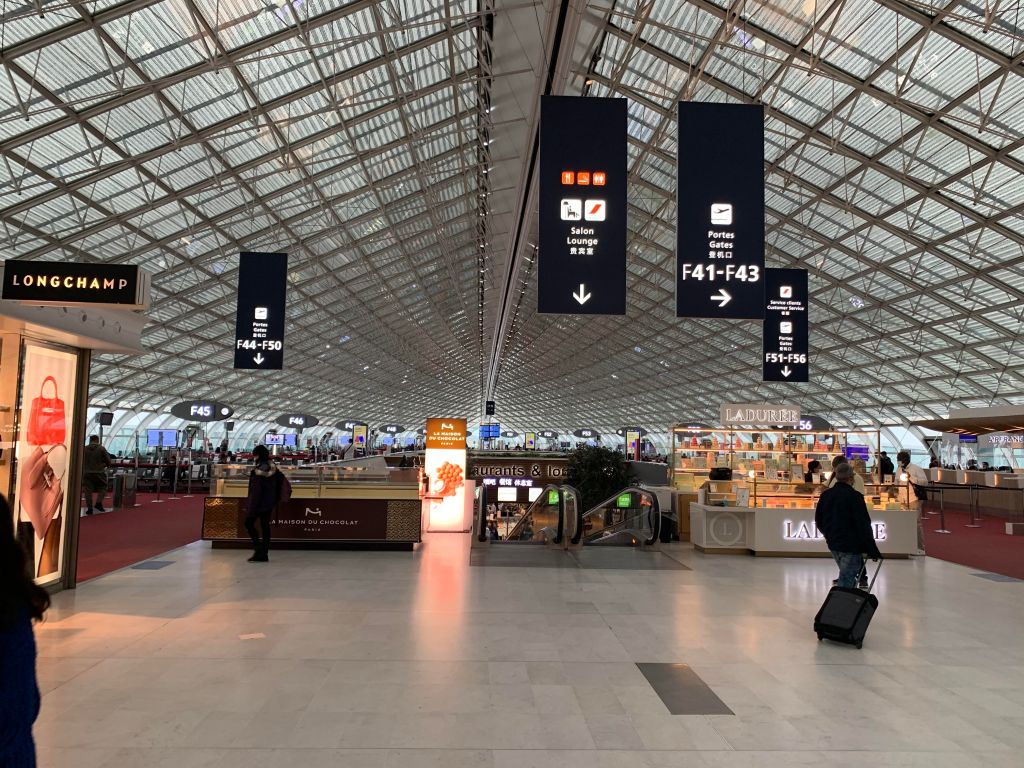
A large part of an airport terminal where the shape of the building forms a parabola, and several visible gates are arranged around the rim.
Impressive architecture at Paris Charles de Gaulle Airport (CDG).

On an inter-terminal train in one airport, there were cartoon illustrations on the floor of each car demonstrating proper social distancing. The problem—these images only showed four people riding at once. Meanwhile, those who arrive during busy times will find their cars so packed that it is impossible to keep the recommended six feet of distance between themselves and the people around them. Boarding lines and, needless to say, the insides of the planes themselves present similar difficulties. With so many people trying to use such small spaces, I can understand, though not agree with, how some seemed to have given up on social distancing altogether.

Another note: what’s the deal with airline food? When drinks or in-flight meals were delivered, most passengers took their masks off and started imbibing all at once. In my itinerary, I had two shorter flights, one of 1 hour and 42 minutes and another of 1 hour and 10 minutes; each one served drinks and snacks, but I would question that decision for flights of that length. I’m sure the airlines have thought about this more than I have, though, so maybe there are non-obvious reasons it is safe. (I have read that staying hydrated is important on planes. Otherwise, the low humidity can make it easier for germs to spread.)

Either way, though. It’s the United States’ domestic situation that relegated it to the high-risk category, but based on my experience, I think anyone traveling by air—even those doing it in relatively safer regions of the globe—are rolling the coronavirus dice to a much greater extent than we were back home in Cleveland (though I suppose the length of time people spend traveling is pretty short, in the grand scheme of things). To whatever extent possible, I think it would be a good idea for anyone who has been through an airport to go into a temporary quarantine.

I am planning to publish some more travel updates here as time goes on—hopefully with more lighthearted topics! See you then.